 Over 80 years after it was first released, Fritz Lang's Metropolis, one of the most influential films ever made, has now been reborn. The discovery of footage long thought lost in Argentina in 2008 has enabled the restoration and reconstruction of a film that is now closer to Lang's original vision than ever before, and now viewers in the UK will finally get the chance to experience it. Metropolis will be re-released in cinemas in September, ahead of its DVD and Blu-Ray release, but I'll be seeing it on August 26th, when it will be receive its UK premiere at the NFT. Frankly, I can't wait.
The Metropolis screening ties in nicely with the BFI's ongoing celebration of its archive's 75th anniversary, which continues in August. There will be more screenings of rare and recently rediscovered titles and a number of nitrate presentations, including Gene Kelly in Anchors Aweigh. Beyond the archive screenings, the Future Human season also continues in August with sci-fi features from the past forty years, ranging from Tarkovsky's Stalker to Spielberg's Minority Report, and including the UK premiere of Second Life documentary Life 2.0 as well as a screening of The City of Lost Children that will be followed by a Marc Caro Q&A. Finally, South American cinema's 21st century renaissance goes under the spotlight (although this season seems to be missing some of the most notable films from this era, such as Amores perros or Y tu mamá también), and Steve McQueen's career is the subject of a retrospective.
From August 13th-15th, the NFT will play host to the third Empire Movie-Con, a weekend of screenings, Q&As and events. The full details of the weekend have not yet been announced, but it has been revealed that the eagerly anticipated Scott Pilgrim vs. The World will round things off with a Sunday night screening. Animation fans will be treated to the International Animation Festival which takes place towards the end of the month, while horrors fans will find all of their bloody needs satisfied at the 11th FrightFest festival, which this year includes screenings of the I Spit on Your Grave remake and the already notorious A Serbian Film. Whether or not I have the desire or the stomach to watch that particularly nasty-sounding shocker is a debate I'm still having with myself.
If you know of any upcoming film events that you'd like me to include in future articles, please let me know at philipconcannon@googlemail.com.
 There's not much I can find to say in defence of a film like The A-Team, but I suppose I can admit that Joe Carnahan's film is admirably honest about its intentions. "Overkill is underrated," Liam Neeson's Hannibal observes towards the movie's climax, and that appears to be this filmmaker's mantra, having left behind the impressively gritty style of his breakthrough Narc for films like Smokin' Aces and this depressing mess; pictures in which the bullet and body count is of considerably greater importance than story and character. That's a particular shame for this movie, because in its TV incarnation, The A-Team's biggest asset was the collection of unlikely companions at its centre; mastermind Hannibal, charmer Face, muscleman BA and crazy Murdock. The actors selected to take on these iconic roles in 2010 may be the perfect choice or they may not, but we'll never truly know, because this picture doesn't give any of them a single moment to breathe.
As Hannibal, Liam Neeson never looks entirely comfortable, and I suspect an actor with a lighter touch would have been a better fit. As the film opens in Mexico, only he and Bradley Cooper's Face know each other, and both are in a right old fix. The process through which they manage to escape and turn the tables on their captors leads them to ex-Army Ranger BA Baracus (Quinton 'Rampage' Jackson) and certifiable helicopter pilot Murdock (Sharlto Copley), before Carnahan leaps forward eight years to find them in the Iraq, where they are about to be framed for a crime they didn't commit.
The story that follows is barely worth devoting any time to because, to be honest, there's barely a story. It took three screenwriters to come up with the tiresome series of double-crosses, faked deaths and leaps of logic that form the movie's narrative, but their prime task appears to have been to find as many opportunities as possible for Carnahan and co. to blow things up. The A-Team is structured (if that's the word) around its action sequences, and you might argue that there's nothing unusual in a summer blockbuster taking such an approach, but those sequences are handled in such a horrendous fashion they immediately negate the film's sole reason to exist. Some of these scenes might have worked in other hands – one early set-piece cuts between Hannibal laying out his plan and the team pulling it off, while a more outlandishly imaginative one tackles the problem of steering a tank that's freefalling through the sky – but surely to enjoy these escapades you'd need to know what's going on.
The rapid-fire editing style embraced by Carnahan turns every action sequence into a shapeless, incoherent jumble of gunfire, flying bodies and fireballs, with the director never making an attempt to give the audience some sense of where his characters are in relation to one another, or where they need to be. This affliction doesn't only apply to The A-Team's money shots either, as Carnahan's inability to hold a shot for more than two seconds eats into the actors' performances. Of the main four, only Copley – who previously excelled as Wikus in the otherwise overrated District 9 – finds something like the right note, delivering a lively and occasionally funny performance as Murdock. Jackson struggles to fill Mr T's shoes as BA, but he has been saddled with an appalling subplot in which his character loses, and then regains, the will to kill. Perhaps this was intended as a sly comment on the TV show's famous refusal to kill off its villains, but it's cringeworthy as portrayed on screen. The rest of the cast barely register, and that includes Bradley Cooper, whose swaggering arrogance seems to sum up the film – so convinced of its own charm, but with no substance to back it up.
By the time The A-Team has reached its incomprehensible climax, which consists almost entirely of crates exploding, it's clear that the film's limited well of inspiration has run dry. For all of the noise and spectacle, this is a crushingly boring cinematic experience; completely empty, soulless and disposal. It represents everything that's lousy about mainstream cinema in the summer months, and coming so soon after the ambitious Inception and the near-perfect Toy Story 3, its laziness and contempt for the viewer is even more unforgivable. If you want to see a film that combines thrilling action with wit and heart, go and see Toy Story 3 instead, and if you've already seen it...well, you'd be better off seeing it a second time. I pity the fool who wastes good money on this junk.
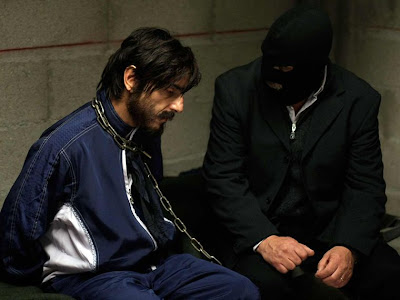 The title card for Lucas Belvaux's Rapt appears twice onscreen during the opening credits, which is the first sign that this film will be doing things a little differently. What could have been a straightforward kidnapping tale is given an extra dimension by the choices this Belgian director takes, and by the manner in which he shifts the focus of the narrative unexpectedly. In a few short, effective strokes, Belvaux sets up his protagonist for a severe fall from grace. Stanislas Graff (Yvan Attal) is the wealthy industrialist who spends his days jet-setting with the French President, but whose nights are spent racking up major gambling debts at poker or spending a few illicit hours with his mistress before heading home to his loyal wife Françoise (Anne Consigny). Oddly, over the course of the film, Belvaux successfully manages to manipulate our perception of this cocky and deceitful character so he eventually earns our sympathy.
And he really does earn it, being put through a terrifying experience by the kidnappers who snatch him in a swift and carefully orchestrated assault. Graff is blindfolded, handcuffed, drugged and taken to an underground location, where the crooks show they mean business by chopping off a finger. The ransom is set at €50 million, which should be no problem for a man of his wealth, the captors reason, but that's where their plan starts to go awry. It seems Graff isn't quite as affluent as the media has suggested, and the corporation he represents shows an unsurprising hesitancy in putting up the cash when revelations about his gambling debts and affairs begin appearing in the tabloids. Belvaux places us in a position of uncertainty regarding Graff's ultimate fate as those who he thought of as his nearest and dearest begin backing away and looking after their own interests. Does anyone even want this guy back?
Belvaux divides his time evenly between Graff's ongoing ordeal, the negotiations between the police and his former business partners, and his family, who are threatening to come apart under the strain. As these discussions about the rights and wrongs of paying the ransom take place in the outside world, Graff begins to feel increasingly isolated, and Attal gives a thoroughly convincing portrait of a confident man rapidly being reduced to a broken, terrified wreck. He flinches and cowers like a beaten dog whenever one of his captors enter the room, and he finally spends much of his time sitting and staring dumbly ahead, seemingly ready to accept whatever fate lies in store, and wondering why he has been forsaken. It's no surprise that he first asks to see his dog when he finally does get home; the only loyalty he can truly count on.
It's not really spoiling Rapt to reveal that Graff does eventually return home. The plot is not the key thing here, as Belvaux seems much more interested in observing human nature, and seeing how these characters react when placed in these extreme situations. While Belvaux stages a couple of tense and gripping sequences, Rapt is ultimately more of a character study than a straightforward thriller, and it impresses on both levels. The final scenes are fascinating, as we watch Graff, a man much changed by his traumatic experience, wandering through the debris of his former life, looking at those around him with fresh eyes, and pondering his next move. Belvaux closes the film just as Graff makes an agonising choice, and in an appropriately ambiguous move, he leaves the audience to speculate on the character's ultimate decision.
 After a career spent shocking audiences with the sexual explicitness of her work, Catherine Breillat's The Last Mistress and her latest film Bluebeard indicate the development of a mellower sensibility. This is certainly the tamest film she has made to date, but the same themes Breillat has always been fascinated by are still present, they're just being played on a more subliminal level. This adaptation of a famous French fairytale allows the director to once more explore the complexities of female desire, but this time there's not an erection to be seen. In fact, there's barely even any exposed flesh on display, apart from one sight of the title character's half-naked corpulence. By Breillat's standards, this is astonishingly chaste stuff, with a scene of voracious meat-eating being the closest Bluebeard gets to generating some kind of erotic heat.
Regrettably, it's all a little dull. Bluebeard is the grim story of a lord who has the habit of marrying and then murdering his wives – he's already been through seven at the story's opening – and Breillat plays the tale in a straight, minimalist fashion, while adding a framing device in which two young girls read the narrative from an old picture book. The main story follows two sisters, Marie-Catherine (Lola Créton) and the elder Anne (Daphné Baiwir), left bereft and penniless when their father dies. Without a dowry to their name, they are left with little choice when Bluebeard (an excellent Dominique Thomas) sends a messenger to invite them to the castle, and the lord eventually settles on Marie-Catherine to be his new bride, taking her home to his imposing castle.
Breillat has not lost her ability to shoot beautiful young women, and her camera often lingers on the faces of Créton and Baiwir, allowing their expressions to tell the story. Créton's guileless and inquisitive performance is particularly impressive, and the director draws natural turns from Marilou Lopes-Benites and Lola Giovannetti as the two children delighting in this dark story. There's one superb moment in the film, when the two narratives, without warning, suddenly bleed into one another (there may be no sex here, but that other Breillat mainstay – blood – makes a vivid appearance), but generally I found the film perplexingly uninvolving. Breillat's detached and academic directorial style keeps us at a certain distance, and while the film is full of beautifully composed shots – including the haunting climactic image – I found myself futilely wishing for something more on the handful of occasions that Bluebeard showed a real spark of life. Breillat's film gets at the heart of darkness that underpins the best fairytales, but rarely has her work left me feeling so frustrated and dissatisfied.
 Joann Sfar is certainly not a man who lacks ambition. For his first film as a director, this acclaimed graphic novelist has chosen to tackle the life of French cultural icon Serge Gainsbourg, and if that wasn't enough of a challenge, he has elected to tell his story in a surreal, unconventional manner that aims for an artistic rather than literal truth. Gainsbourg (Vie héroïque) is a fascinating and distinctive portrait of a unique artist, and I met the young director in London last month to talk about it.
When did you first discover Serge Gainsbourg and why did he become such an important figure for you?
Not only to me but I guess to French youth. Gainsbourg was the only guy with an attitude on French television. Everything was so boring on French television when I was a kid and this guy, he was not shaved, he pretended to be dirty, he would say dirty words and almost harass women on stage, and yet he was so intelligent at the same moment. He always mentioned sex and alcohol and so on, and when you are a kid and you see this guy, you want to grow old. He's the guy who makes you feel that being a grown-up is so cool. Then when you discover his work you find also the sadness and the kind of cliché of the French Don Juan, the Russian-Jewish spirit which is almost mad and desperate with love, and it's very appealing for a storyteller.
So it was his rebellious spirit that most attracted you to him?
This is a strange question because he always claimed to be a rebel, but the truth I guess is that he wanted to be loved. He would do any silly thing for people to take notice of him, even if it meant hating him, but he could not stand the idea of people not talking about him or forgetting about him. His main idol was Salvador Dali, so you can imagine kind of behaviour he wanted to have. He would open a newspaper and if his name is nowhere it's a tragedy for him.
Your film suggests that the events of his childhood informed his whole life.
I've heard many things about Jewish people during World War II, but his story in my perception is very strange. He had no idea about being a Jew, there were no religious activities in his family and then one day the French police call him and give him the yellow star. So it is very strange to have a religion that is given by the administration of your country and he had a very strange relationship with France. After 50 years, he invites black Jamaican musicians to rob and sing the national anthem, so it is an answer to his childhood and it was a long, passionate relationship with France. I also love the symbolic relationships he had with women and clearly he wanted to conquest France through women and through love stories. I feel that when he had those three months of passion with Brigitte Bardot it was clearly a symbolic love story, and maybe one of the motives of the movie is that I wanted to shoot Brigitte Bardot. You know, I say this as a joke, but if you have been drawing for twenty years and they give you a camera, you want to put a real fantasy princess on screen, and Brigitte Bardot is a hit not only for French people but everyone.
Was it difficult to decide what aspects of his life to focus on in the script, and which ones to leave out?
The main concern was not Gainsbourg, the main concern was that I don't know how to write a movie. I am quite used to writing comic books and I didn't want to listen to the masters of scriptwriting because it would like having the master of sex in the room while you are performing [laughs]. I'm perfectly aware of the fact that I don't know how to structure a movie and I'm not quite proud of the structure of my movie. I worked with what I knew like dialogue, image, colour, scenes, and I have to confess I'm proud of the actors, the image and the scenes, but maybe I'm not quite proud of the structure because I'm learning. I don't know how to give simplicity to the structure of a movie. I did structure this movie as I would have done for a comic book and I've got to improve this, because when you've been performing an art form for a long time, on the one hand you respect the rules and on the other hand you want to break the rules. That's what I do in graphic novels, but I have just discovered movies so I have to learn the grammar and at the same moment show disrespect to this grammar, and perhaps that's too much of a burden for my first movie. I had no idea it would be so complicated to mix songs, children, animals, puppets, I didn't know that the production would be so difficult.
I'm very happy that I went through this movie, because afterwards everything will be easy for me. For instance, I was so surprised and happy to see the audience laugh because I had no idea I could write comedy moments. In the future I only want to write comedies, whether they are children's comedies or adult-oriented, because I am so happy when people laugh, and writing an emotional line is quite new for me. I'm in the beginning of a learning process, and I say all this because I don't want to say, "Oh, I'm an artist, this is how I see my movie," I'm not like that. This might sound very pretentious but I would like to do intelligent entertainment. I don't feel I'm there yet, but I'm on my way.
While I was waiting outside I was told that there is a re-edited version in the works for the film's general release. Can you tell me more about that?
Yes, I did that. It isn't finished yet but it will be released in London next month, that's what you will see in the theatre. It will be about 15 minutes shorter. It does not change big things to the story, everything is here, but the language is quite different, and I understood many things. The film appears to address a younger audience. It is as complex but with more rhythm.
How did your background as a comic book artist help you shape the film's visual style?
The useful stuff was not comic books it was drawing. When you know nothing about technical cinema terms, not only with the camera but with the wardrobe, production design and so on, you need to make very precise drawings. You show them to the technicians, you wait for their answer, which will be very concrete, and then you draw again. Even with things like the focus on the camera, I don't know the names but I know precisely the kind of picture I want, so we try all of them. It's a very good way to talk to a technician because he can interpret the drawing, and he does not feel he is your slave, because he has a lot of invention as well. We made thousands of drawings through the movie, and they told me they were very happy to work this way.
Were there cinematic influences on your approach as well?
Maybe there is one; it would be An American in Paris. I wanted to have all of the clichés of a love story on the bank of the river Seine, like in Everybody Says I love You which was already a reference to An American in Paris. I wanted to shoot it on the real location but to make it look fake. I don't want my life to look like real life I want it to look like a movie, so there's a lot of light and a lot of colour. I would love to do a musical and I love the idea of doing a romantic comedy.
That sense of unreality is in the script as well, and we get the idea that we are not watching the historical reality of Gainsbourg's life.
I'm taking everything as it was said. It has been highly documented but it is documented only in his voice. The other thing is that I don't like it when a movie has the camera moving on the shoulder and you pretend that what you say will be more true because the camera is moving like you are a journalist and not a storyteller. My whole point is that you can give true emotion through fake image, and that's the whole point of live theatre. When you read Shakespeare, when you read A Midsummer Night's Dream, you know nothing about fairies but you know many things about feelings. I love to do this, and even though Brigitte Bardot is still alive, I love to treat her as a princess from the middle ages, as an icon. This is clearly not a realistic cinema but I hope people really cry and I hope they really laugh.
It can be controversial to take a non-historical approach to an iconic figure, though. Have you had any criticism for this approach?
Fortunately, it was wonderful when the movie was in Paris. Maybe they were easy because it's a first movie, they might shoot me for the second one! [laughs] We have sent the movie to 30 countries, but most of the time people don't even mention Gainsbourg who they don't know, and instead they say it is a love story in Paris with Brigitte Bardot, which is fine for me. I feel I was working more on the art of Gainsbourg than on his accurate life.
I understand you are currently working on a screen adaptation of your comic The Rabbi's Cat?
Yes, we finished the animation two weeks ago, and we are having very good screenings. We are considering putting it in 3D, but I am very stupid because this will add five months of work. We have to work on almost every shot of the film again because we have to change the floors and the space and so on, but I hope it will be released next February.
And do you think you'll focus more on animated films in the future, or will you direct more live action?
First I'd like to do more comic books, but I created a production studio for The Rabbi's Cat and I am not the only director, there are others. Our movies will be clearly European and worldwide oriented, I don't want to just stick to French audiences so most of our movies will be English-speaking movies, and we are considering working with the Universal studio in London because we are very fond of them. We are in the beginning of the process, but maybe one day we could create a studio like the Aardman studio or Miyazaki's studio, where they are a universe and every year you go back to their universe. Not every movie will be good but it's about writing a line from one year to another.


