 Herbert Ross’ excellent 1972 film Play It Again, Sam begins with Woody Allen in a darkened cinema, his mouth agape, his eyes wide open as he sits transfixed by the scene playing out in front of him. The scene in question is the climactic sequence from Casablanca, with Humphrey Bogart telling Ingrid Bergman to get on that plane, and Woody hangs on every word as the actors recite some of the most memorable dialogue in film history. They don’t make ‘em like that anymore.
That opening sequence came to mind as I watched The Good German, a film which admires the classical Hollywood pictures of the 30’s and 40’s much as Woody stares lovingly at Michael Curtiz’s famous love story. Steven Soderbergh’s adaptation of Joseph Kanon’s novel is his attempt to make a Casablanca for a modern audience; but by the time the director has given us his own version of the scene referred to above, The Good German has long revealed itself to be a clueless and hollow pastiche. It’s a film which aims to slavishly recreate every technical aspect of those great films which have gone before, but in doing so it spectacularly misses the point of what made those films great in the first place.
The Good German captures the surface details of old Hollywood pictures, but it’s not those details which make films like Casablanca and The Third Man such established classics; it’s their slick writing, iconic performances and clear-eyed direction - all aspects which The Good German lacks. It also lacks any sort of involving story, with Paul Attanasio’s screenplay blandly sketching the links between plot points in a fashion which wouldn’t pass muster in any era. Jake Geismer (George Clooney) is an American reporter who has returned to Berlin to write about the forthcoming Potsdam peace conference. His driver Tully (Tobey Maguire) is a cocky young soldier just who loves this dirty town, with plenty of money to be made on the black market and plenty of women turning to prostitution in such difficult times. Tully, however, only has eyes for Lena (Cate Blanchett), a German woman who happens to be an old flame of Jake’s.
When Jake runs into Tully and Lena he’s also unwittingly running into a complex plot which is too dreary and incoherent to relate in any detail here. There are twists aplenty, duplicitous characters and hints at a larger conspiracy, but it all unfolds with a startling lack of grace and a thick fog of confusion envelops much of its narrative. In fact, one gets the sense quite early on that Soderbergh’s heart isn’t really in this film’s story, and instead we find the director obsessing over the minutiae of his production.
The Good German isn’t just a film set in the 1940’s, it has been produced as if it were a film made in the 1940’s. Soderbergh has aped the look and sound of the era, imposing strict guidelines upon his crew as he attempted to recreate the conditions under which directors of that age would have made their pictures. He even used original lenses, traditional boom mics and large, incandescent lights to bring a bygone age back to the big screen. Stylistically, the film frequently utilises a standard mise-en-scéne, with occasional swipe-cuts and stock footage being thrown into the mix; and the only concessions Soderbergh makes to the film’s contemporary status is the introduction of sex, violence and strong language (incongruously, Clooney gets to say “fuck a duck”) which would have been outlawed by the Hayes Code. But The Good German never feels like a 1940’s film, it feels like a soulless copy of a 1940’s film, which is exactly what it is. Even the supposedly meticulous recreation feels off; the lighting is too harsh, the set-ups are too static, Thomas Newman’s score is too generic - we’re never allowed to forget the fact that we’re watching a movie.
In truth, the closest point of comparison isn’t a film from six decades ago, but a film from just a few years ago. Todd Haynes’ Far From Heaven was another attempt to reproduce a certain style of filmmaking, namely the lush 50’s melodramas of Douglas Sirk, with some more modern sensibilities being carefully crafted onto a straightforward structure. But Haynes seemed to have an implicit understanding of the genre he was exploring; his production matched the Technicolor beauty of Sirk’s films, but it retained a life of its own; his actors gave performances which were studied in the 50’s style, but they were rich with subtle nuances; and the score by Elmer Bernstein recalled past efforts while also being completely in tune with the story’s emotions. Far From Heaven, despite being a film rooted in the past, was one of the freshest and purest cinematic experiences of 2002; but while Haynes’ film was an act of loving homage, The Good German never looks like anything other than a cold technical exercise.
In contrast to Far From Heaven’s pitch-perfect performances, the actors involved in The Good German are all at sea. Clooney has movie star charisma to burn, but he’s always at his best in roles which allow him to play on the lighter side of things - he’s more Cary Grant than Humphrey Bogart - and he gives a stiff, buttoned-down performance here which does him no favours. “He didn’t look like a patsy” Tully’s voiceover muses when he first meets Jake, and it’s true - Jake doesn’t look like a patsy - but he’s not much of a hero either, and Clooney’s unsure display is fatal for the picture. The boyish Maguire is miscast as the rowdy, conniving Tully; and while Blanchett’s attempt to channel the spirit of Dietrich and Garbo is a little more enjoyable, none of the three principal characters are ever allowed to breathe. They each get a slice of the film’s voiceover, but their motives remain obscure, and the interplay between the characters remains lukewarm.
This is a hugely disappointing stumble for Soderbergh. He has had an extraordinary run since his mid-90’s Hollywood resurrection, but the best films in his long purple patch - Out of Sight, The Limey and Traffic - have all been loose and sprightly affairs, which is what makes this film all the more baffling. In putting himself under such restrictions, Soderbergh has sucked all the spark out of his usually vibrant directing style; the film has no heart, and no life of its own. It’s just a stupendously dull stroll through a witless, directionless story peopled by characters you couldn’t give a damn about.
The Good German concludes on an airfield, with two former lovers standing in the dark while a nearby plane prepares for imminent departure. It’s practically a shot-for-shot replay of Casablanca’s famous finale; but while that scene went down in history, this version is one of the most anticlimactic endings it’s possible to imagine. The Good German is a dreadful, empty, pointless film; and while the pictures Soderbergh has drawn inspiration from are still revered six decades after their production, few people are likely to recall this insipid act of mimicry with similar affection. I guess they really don’t make ‘em like that anymore.
 “I don’t know what happened” Laura Dern somewhere in the second half of INLAND EMPIRE, “it’s kinda laid a mind-fuck on me”; and most of the viewers who subject themselves to David Lynch’s latest film will know exactly how she feels. INLAND EMPIRE - the director prefers the title to be spelled in capitals - is Lynch’s first offering since his magnificent Mulholland Drive, and it’s the most challenging and experimental picture the auteur has produced since his debut Eraserhead, thirty years ago. It will probably divide people more than any other Lynch film; some will hail it as a work of genius, an avant-garde masterpiece, while others will hail it as a self-indulgent catastrophe. Most, I think, will pitch their opinions somewhere in the middle ground between those viewpoints.
But whatever you think of INLAND EMPIRE, there’s no disputing the fact that this is one of the most difficult and uncompromising films David Lynch has ever made. The director has for decades stretched the limits of traditional storytelling, and here he blows any sense of narrative coherence or logic to smithereens, plunging viewers into a full-on three-hour nightmare. It will undoubtedly be too strong a brew for some viewers, but after two viewings of INLAND EMPIRE, I can’t get it out of my head.
So what is INLAND EMPIRE all about anyway? An attempt to lay out this film’s plot may be a futile exercise, but on a basic level it’s about an actress named Nikki Grace (Laura Dern) whose flagging career might be set for a boost with a ludicrously titled movie called On High in Blue Tomorrows. The film opens with Nikki awaiting her agent’s call, and receiving a strange visitor (a vivid Grace Zabriskie cameo) who asks cryptic questions, speaks in riddles and tells Nikki that her film will feature a “brutal fucking murder”, despite the actress’s denials. On High in Blue Tomorrows is a southern romance which is being directed by Kingsley Stewart (Jeremy Irons) and co-stars notorious womaniser Devon Berk (Justin Theroux), but there’s a dark secret behind this seemingly straightforward picture.
Just before cameras start to roll, Kingsley tells his actors that the film they’re working on is in fact a remake of an unfinished Polish film which was abandoned after both of its leads were murdered; and after this revelation INLAND EMPIRE begins to go down some very strange avenues. The lines between Nikki’s life and the film she’s shooting begin to blur, and on top of that they are mixed in with scenes from the Polish movie which met such a tragic end. Is that not enough for you? There’s also a bunch of prostitutes who spend their days lounging around a flat when they’re not spontaneously bursting into song, and Julia Ormond plays a woman who is adamant she’s going to stab somebody with a screwdriver - like the one which is currently sticking out of her stomach. Another young woman sits in a room weeping uncontrollably while staring at a TV screen, a group of travelling circus performers show up, and let’s not forgot about the six-foot rabbits in human clothes who appear to be starring in their own sitcom. INLAND EMPIRE is a movie within a movie within a.... well, you get the idea.
After the glories of Lynch’s Mulholland Drive - the greatest American film of this young century - INLAND EMPIRE is inevitably something of a disappointment. At three hours the film is overlong, too much of it feels like material recycled from Lynch’s earlier films, and the picture occasionally threatens to slip into self-parody. INLAND EMPIRE’s narrative is a shapeless mess which unravels with wild abandon before the various strands overlap and devour each other - we see scenes repeated at different points, or perhaps replayed from a different perspective. This meandering approach leaves the film feeling a little baggy and repetitive, with the final hour in particular struggling to maintain much momentum, and Lynch makes some errors in his pacing of the film allowing a number of scenes to run on beyond their natural length. One sequence towards the end of the film exemplifies this problem perfectly; a badly injured woman collapses to the floor between two vagrants, who carry on with their inane conversation while she lies prone between them. This sight is funny at first, but it soon drags into tedium, and such longueurs pop up too frequently in INLAND EMPIRE.
And yet, for all its flaws, INLAND EMPIRE has somehow managed to lodge itself firmly in my brain, staying with me while so many more refined and coherent films have drifted into obscurity. There’s something about David Lynch’s films that gets under my skin in a way few filmmakers can manage. He’s a master of atmosphere, and INLAND EMPIRE is dripping in that uniquely Lynchian sense of dread; that creeping feeling of terror which seems to grow out of the most innocuous situations. All of the director’s standard tropes are here - flickering lights, red rooms, a portentous soundtrack - and they have lost none of their potency. For most of INLAND EMPIRE I was enthralled by what I was watching - at its best, the film exerts an almost hypnotic power - and on a scene-by-scene basis, it contains as many brilliant moments as I’ve seen in any film this year. One inexplicably chilling scene sees Dern’s character wander into a room full of prostitutes, who shine torches in her face while making oblique comments, and the shooting of another character late in the film provides us with a truly nightmarish image. Lynch also punctuates the action with terrific musical moments: an impromptu rendition of The Locomotion, an inspired use of Beck’s Black Tambourine, and the end credits - set to Nina Simone’s Sinnerman - are simply fabulous. Visually, the film will be a test for some viewers. Lynch’s decision to shoot on low-tech Digital Video means the film lacks the glossy, dreamlike quality of the sumptuous Mulholland Drive, but it works for the picture in a different way. The harsh flatness of the DV image is jarring at first, particularly during scenes set in daylight, but as the film progresses it seems to accentuate the darkness being explored; giving an even eerier edge to the film’s endless murky corners. It might not be pretty, but it’s brutally effective.
Even if INLAND EMPIRE isn’t the handsomest film around, it’s impossible to tear your eyes away while Laura Dern is onscreen. This is the performance of a lifetime; a multifaceted, stunningly complex, emotionally naked piece of acting which towers over anything produced by this year’s crop of Oscar contenders. Dern plays a wide variety of characters here - a Hollywood actress, a housewife, a battered prostitute - and she gives an astonishing performance in every role. She has a monologue late in the film, where she sits in a room and slowly describes the abuse she has suffered in a thick southern drawl, and she gives the speech such resonance it’s simply breathtaking to witness. There are outstanding performances right through INLAND EMPIRE - Justin Theroux’s smooth lothario is brilliantly played, Jeremy Irons makes the most out of a thin role, Harry Dean Stanton is hilarious - but Dern is the glue which holds this film together. It’s not the kind of performance they hand out Academy Awards for, but it’s a performance for the ages.
INLAND EMPIRE is pure, undiluted Lynch; and you can either resist the weirdness or simply surrender yourself to it completely. I’ve now seen the film twice, and I found it a much more satisfying experience second time around, when I gave up looking for some logical answer to the film’s conundrums and simply allowed myself to be swept along by the director. INLAND EMPIRE is massively flawed, but the more I think about it the more I like it; for better or for worse, this is a unique cinematic experience and I can’t wait to see it again. This is the work of an artist who is constantly exploring the boundaries of cinema, and his experiments here have thrown up sights and sounds which few other filmmakers would even dream of. Nobody in the world makes films like David Lynch, and it remains a pleasure to be baffled by him.
 When David Beckham recently signed for American side LA Galaxy, the makers of Goal II: Living the Dream must have had mixed feelings about the move. Sure, Beckham’s increased profile in the US might be good for the picture’s chances of making an impact there, but it does render this second instalment in the football trilogy even more outdated than it already was. Goal II sees Santiago Munez (Kuno Becker) making the move from the Premiership to La Liga, swapping the black and white of Newcastle for the all-white strip of Real Madrid; but along with the US-bound Beckham, the film sees Santiago lining up next to such players as Thomas Gravesen (now at Celtic), Julio Baptista (Arsenal), Jonathan Woodgate (Middlesbrough) and the great Zinedine Zidane (famously retired).
Such are the pitfalls of trying to make a feature film in the fast-moving football world, but that hiccup is the least of Goal II’s problems. I rather enjoyed the original film, which saw young Mexican Santiago making the move to Newcastle after being spotted showing his skills in an LA park. The film’s fairytale narrative followed a traditional trajectory, with our hero overcoming every obstacle through sheer hard work and determination. It was nothing new, but the film did deserved some credit for its fine recreation of match day action - with the actors skilfully spliced into real-life footage and a number of players making cameos - and the general air of authenticity which Newcastle’s cooperation on the picture enabled.
Goal made little impact on its release in 2005, but part two had gone into the works as soon as production on the first film had finished, so here it is whether people are interested or not. The film opens with a display of skill that won’t be matched in the whole picture, with the opening credits running over footage of Ronaldinho’s single-handed destruction of Real Madrid in 2005 (he famously became the first Barcelona player to earn a standing ovation at the Bernabéu since Maradona 20 years previously). Clearly, things are not going well for Real, and one player under particular scrutiny is Gavin Harris (Alessandro Nivola), the new signing from Newcastle who has struggled to live up to his transfer fee.
Real Madrid manager Rudi Van Der Merwe (a blatantly uninterested Rutger Hauer) thinks the solution to Harris’ problems might be the purchase of his former team-mate Santiago Munez, and he begins to make arrangements for a swap deal involving Michael Owen. It’s a dream move for Santiago, but he soon finds the pressures of playing for one of the world’s biggest clubs are very different to those he faced in Newcastle. His fiancée Roz (a decent Anna Friel) struggles to settle, causing tensions to rise between the pair, and Santiago starts to get sucked into the playboy lifestyle enjoyed by the likes of Gavin Harris. He has problems on the pitch too, finding himself restricted to the bench and struggling to make a mark at his new club.
In other words, it’s nothing new, with only a sunnier milieu marking the difference between this Goal and the original. Of course, we shouldn’t have expected Goal II to break any new ground, but this sequel feels like a serious regression from the (admittedly quite low) standard set by Danny Cannon’s film. The director this time out is Jaume Collet-Serra, the young Frenchman whose previous effort was the much derided horror remake House of Wax, but he doesn’t bring much to the film aside from a lot of flashy visuals and choppy editing. Few of Collet-Serra’s aesthetic choices are pleasing; the overuse of CGI in the football sections - with balls defying the laws of physics as they swerve into the net - makes the in-game action feel cartoonish, while a snowstorm during a European match in Norway just looks ugly, and there’s a bizarrely incongruous car chase sequence which comes out of nowhere halfway through the picture.
Goal II does make an attempt to give Santiago’s story some sort of emotional resonance in this film by introducing his long-lost mother (Elizabeth Peña), and the brother he never knew he had (Alfredo Rodríguez), but this strand of the narrative barely rises to the level of a Soap Opera. Kuno Becker’s mediocre performance also scuppers the film’s chances of developing any depth; he just about got away with his limited range in the first film, but here his handful of scowls, smiles and confused expressions quickly palls, particularly when Santiago is supposed to be going through such a difficult and transformative time. Thankfully Alessandro Nivola lightens the mood a little by reprising the character of Gavin Harris to winning effect. Nivola’s cocky, dopey star was the best thing about the first film, and he again manages to eke a couple of laughs out of the generally barren screenplay. In this picture Harris is worried about the ageing process, and the thought that he might lose his place in England’s World Cup squad to younger legs, and Nivola’s relaxed performance makes him a far more rounded and appealing character than Becker can manage with far greater screen time.
Aside from Nivola, there isn’t much fun to be had with Goal II, although the star-spotting is always enjoyable. Few of the Madrid players are given much to do other than sitting around in the background of scenes, but Thomas Gravesen does engage in a nice bit of towel-swiping comedy, and the likes of Míchel Salgado and Iker Casillas handle their brief appearances with the minimum of fuss. The weirdest cameo of the lot comes from Steve McManaman, though. The Associate Producer pops up as Rutger Hauer’s assistant, and he seems to be lurking in the background of almost every single scene, finally excelling himself with some great “leave it, he’s not worth it!” action when breaking up a fight. And what of Mr Beckham himself? Well, after delivering his one line in Goal with all the confidence of a man who has never spoken English before, he has found himself back among the subs this time, only making wordless appearances. Never mind, David; just think of all those acting classes you can take in LA.
Goal II ends, as you’d expect, with a Real Madrid victory secured by a last-minute stunner (shamefully bastardising one of Arsenal’s great European performances in the process), but there’s no real sense of joy in this disappointing retread. For all its flaws, the first Goal had a degree of charm, plausibility and a lightness of touch which is completely missing from Collet-Serra’s glossier, emptier movie. Instead of advancing on the things Goal did well, the sequel just expands on the things it did poorly, and it’s a major backwards step for the series. Of course, we still have Goal III to consider - the action will be taking place at the World Cup, with Santiago and Gavin competing on the world’s biggest stage - but it’s hard to hold out much hope for the film after this instalment. “To be continued” the film promises as the credits roll - the question is, will anybody care?
 Dreamgirls may only just be arriving in cinemas, but we seem to have been living with it for a long time already. Some time early last year we began to hear the first rumblings of the hype machine kicking into action, letting us know that something big was on the horizon. A few months later, many industry insiders were inexplicably hailing it as a guaranteed Best Picture winner before any footage from the film had even been seen; and before its official release date, Dreamgirls played a limited run at select US cinemas for $25 a go - it was a marketing campaign which seemed to be calibrated to perfection.
Then, the Academy Awards nominations were announced, and Bill Condon’s film found itself unexpectedly shut-out in the major categories, with 3 of its 8 nominations occurring in the Best Original Song slot. Over the next couple of days many people speculated on the reasons for Dreamgirls’ underwhelming Oscar showing, but there’s really just one reason which matters: Dreamgirls has its moments, but it’s really not much of a picture.
Dreamgirls is the story of three aspiring singers who have been performing together since the age of twelve, with little success. Deena (Beyoncé Knowles) is the beautiful, level-headed one with the good voice; Effie (Jennifer Hudson), the lead singer, is the larger, stubborn one with the titanic voice; and Lorrell (Anika Noni Rose) is the quieter, optimistic one whose voice is somewhat drowned out by her colleagues. Together they’re The Dreamettes, and the film opens with them suffering disappointment yet again when they lose a local talent show, but fate intervenes in the shape of Curtis Taylor Jr. (Jamie Foxx), a car salesman looking to make some headway in the music industry. He offers them the break of a lifetime, the chance to go on tour as backing singers with Jimmy ‘Thunder’ Early (Eddie Murphy); and so begins a journey which will lead the girls to both success and heartbreak.
As Curtis tries to push Jimmy’s music beyond the black stations which he has been restricted to, it’s his backing singers who begin to catch the attention of various managers and producers, and The Dreamettes are offered their own act, but only if Deena takes over the leading vocals from Effie. Curtis tells Effie that they’re simply looking for a lighter touch to appeal to mainstream audiences, but it’s clear that ‘lighter’ in this context means ‘whiter’, with Effie’s booming, distinctively black voice being dropped in favour of the blander and more conventionally beautiful Deena. Curtis then drops Effie for Deena in the bedroom too, and Effie is eventually forced out of the band, drifting quickly into obscurity and poverty.
Does this sound familiar? It may well do, because with Dreamgirls there’s a story behind the story. The 1981 Broadway musical from which this film is adapted was a thinly-masked depiction of The Supremes’ rise to stardom. Deena is Diana Ross (the group eventually morphs into Deena Jones and The Dreams) and Effie is Florence Ballard, who died at the age of 32, penniless and an alcoholic. Foxx is Berry Gordy Jr, Ross’ lover as well as the driving force behind The Supremes’ success; while Murphy seems to be an amalgamation of various R&B singers - taking a little bit from artists like James Brown, Marvin Gaye, Little Richard and Sam Cooke. The stage musical is a tough act to follow; it was a Broadway sensation, winning 6 Tony Awards and running for 1,522 performances.
Bill Condon’s attempt to translate this winning formula to the screen is seriously flawed, but most of those flaws occur in the film’s second half, and Dreamgirls’ opening act is pretty good fun. There’s an energy and exuberance to the picture, with most of it provided by Eddie Murphy, and after lending his talents to so many unworthy films over the past decade, it’s a pleasure to see Murphy recapturing some semblance of the abrasive, cocky attitude which defined his brilliant early performances of the 80’s. When Murphy is strutting his stuff on stage he energises the whole picture; in one brilliant moment, a backstage rehearsal segues seamlessly into a fantastic live performance. Murphy also brings a note of sadness to the part of a fading star trying to claw his way back to the top, but it’s his thrilling showmanship which really makes a mark on the film.
Murphy’s display is all the more valuable when held against the desperately poor performances turned in by the nominal leads, Jamie Foxx and Beyoncé Knowles. Foxx’s Curtis is a one-dimensional schemer, and the actor doesn’t imbue the part with any of the vitality or nuance he has displayed previously. His dreary, flat singing voice also rankles alongside his co-stars’ strong vocals, and Foxx never seems particularly comfortable in the role. Knowles looks and sounds like a dream when she’s singing on stage, but as soon as she’s taken out of that comfort zone and asked to act, her weaknesses are exposed. She’s an emotional blank, and she never develops much of a personality as the film progresses. Foxx and Knowles’ wan performances are damaging for the film, but the supporting players do some good work; Danny Glover and Keith Robinson give their supporting roles a touch of pathos as they watch Curtis and Jimmy ride roughshod over their dreams, and Anika Noni Rose gives a lovely performance as the third Dreamette, which unfortunately seems destined to be overlooked.
But Dreamgirls belongs to Jennifer Hudson. The former American Idol contestant is making her acting debut here, and what an astonishing debut it is, comprehensively stealing the film from the more established stars around her. Hudson gives a natural, funny, moving performance which provides Dreamgirls with its only source of real emotion. She also gets the opportunity to perform the song And I Am Telling You I'm Not Going, a song which she tears into with blistering intensity. Her powerhouse singing is by some distance the highpoint of the movie - even if it goes on too long - but it’s also something of a double-edged sword.
And I Am Telling You I'm Not Going is the kind of showstopper most movies would kill for, but it quite literally stops the show here. After this moment, which marks the end of Act 1, Dreamgirls staggers around for a while, as if it has been left punch-drunk by Hudson’s emotional outburst, and it never really recovers. After the fun of the movie’s first half, Dreamgirls’ second hour is a maudlin disappointment, with the endless unmemorable songs (even Hudson’s centrepiece is notable more for her lung-bursting rendition than anything else) failing to become much more than background noise. Condon lets his grip on the film’s pacing slacken badly in the final third, and the rushed chronology and poorly-drawn characters preclude any real emotional impact as the story hits all the clichéd beats you’d expect. Dreamgirls is the kind of picture which needs to build to a big finale, but Condon has already played his hand with Hudson’s explosive song, and he can’t find anything to match it as the picture drifts to a drab conclusion.
Dreamgirls isn’t really a bad picture per se. There is a lot to admire in the slick way the film is put together, a few of the performances are strong, and its depiction of the way black musicians watered down their music to appeal to a mass audience is interestingly depicted; but it’s a hard film to really get excited about. There’s nothing new here, nothing daring or ambitious about the way this story unfolds and, aside from one star-making moment, there’s nothing to really engage the emotions. Dreamgirls is a film convinced of its own brilliance when it truth it’s a strictly average piece of filmmaking, and it’s only when Hudson or Murphy take centre-stage that you can see the movie briefly displaying some soul.
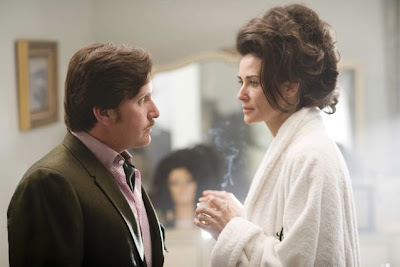 Take a walk through the doors of the Ambassador hotel and you’re guaranteed to spot a few famous faces. Look, there’s Harry Belafonte and Anthony Hopkins playing chess, there’s Emilio Estevez walking his dog, and over there you’ll see Martin Sheen playing tennis with Helen Hunt. Let’s skip past William H Macy and Christian Slater having a row about racism and get something to eat; perhaps a meal cooked up by Laurence Fishburne will fit the bill? After that we can get a manicure from Sharon Stone, go and watch a drunken Demi Moore performing on stage, or maybe we could score some acid from stoned hippy Ashton Kutcher.
There are celebrities squeezed into every corner of Bobby, but none of them take the role of the titular character. In fact, despite the title, Emilio Estevez’s film isn’t really about Robert F Kennedy at all - the senator only makes fleeting appearances here, in archive footage or with brief shots of the back of his head. Instead, the film is about what Kennedy meant to the American people, and what his death meant to the country at large. Bobby is set on June 5th 1968, in the hours before Kennedy was shot by Sirhan Sirhan in the kitchen of the Ambassador hotel. With that assassination, Estevez suggests, the brightest hope for America’s future was cruelly snatched away.
There probably is a great film to be made about Robert Kennedy and his thwarted legacy, but Bobby definitely isn’t it. Estevez is going for something big here, a wide-ranging look at 60’s Americana which tries to depict the impact of an extraordinary man through the lives of ordinary people; but the final film doesn’t come close to matching his laudable ambitions. Bobby is a sluggish, clichéd and dramatically inert picture, and hardly a fitting tribute to its subject. It aspires to the status of something like Robert Altman’s masterpiece Nashville, but a better comparison would be Grand Hotel rewritten by Paul Haggis.
Bobby’s biggest problem is paradoxically something which might have been seen as its biggest asset - the cast. With some 20-odd characters at his disposal, Estevez struggles to find a proper place for every member of the starry ensemble, and as a result the appearance of so many household names is (a) distracting and (b) pointless. Few of the players are given the time and space required to breath life into their paper-thin roles, and none of them can create characters big enough to exceed their real-life celebrity status. Watching Martin Sheen and Helen Hunt argue over shoes is a curious experience when we only see the actors and haven’t got a clue who they are supposed to be playing; and this weird disconnect between performer and role pervades the whole film.
It’s no surprise to see the actors’ performances suffer under the circumstances, and the displays here are generally mediocre. The one star who does make an positive impact is Sharon Stone, surprisingly bringing soul and emotion to the picture, and she’s probably the one person who can view this picture as a success. The likes of William H Macy, Laurence Fishburne and Martin Sheen are hardly stretched with this material, but they’re reliably professional about it and at least they sometimes give their scenes a little spark; few others can even raise their game to that level, though. Demi Moore overacts horribly as the permanently soused diva, Lindsay Lohan and Elijah Wood are insipidness squared, Helen Hunt is annoyingly one-note, and Ashton Kutcher’s turn as a hippy is hilariously unconvincing.
Perhaps Estevez could have fashioned Bobby into something worth watching if he had simply cut down on the amount of things going on at the one time and allowed a few of the more relevant strands to develop, because there’s a lot of stuff here which feels ridiculously inconsequential. When the film is building towards such a tragic event, why are we supposed to care about Demi Moore’s drunken ramblings? Or the marriage of convenience between Lohan and Wood? Or Macy’s adultery? Given the fact that few of these walking clichés have anything to do with the subject at hand - except by the most tenuous of tangents - couldn’t Estevez have found time to at least play lip service to the motives behind Sirhan Sirhan’s attack? He was a Palestinian who was outraged at Kennedy’s pro-Israel standpoint, but all we get is an anonymous young man who turns up at the hotel out for blood, bumping shoulders with the director as he does so.
As a director, Estevez is sloppy and unfocused. His pacing is poor, he slips too easily into hackneyed scenes (like a hugely embarrassing ‘trip’ sequence after a couple of kids try LSD for the first time) and his habit of tossing endless cultural references into the film (The Graduate, Andy Warhol) feels like lazy name-dropping. As a writer, Estevez has a tin ear, allowing too much platitudinous dialogue to pass the actors’ lips, and many scenes in Bobby feature people sitting around literally discussing the picture’s major themes. Everyone gets the chance to deliver a speech on the importance of democracy, tolerance and humility; but the screenplay’s appallingly trite and unsubtle nature continually makes Bobby’s lessons and epiphanies ring resoundingly false.
There’s no doubt that Bobby is a very bad film, but it’s a very bad film which happens to have a very good ending. When the fateful shots are fired, Estevez suddenly shows himself to be remarkably adept at depicting the ensuing chaos and dismay; he cuts the sound, and allows the speech Kennedy made after Martin Luther King’s assassination to run on the soundtrack. It’s a brilliant move. “What has violence ever accomplished? What has it ever created? No martyr’s cause has ever been stilled by an assassin’s bullet. No wrongs have ever been righted by riots and civil disorders. A sniper is only a coward, not a hero; and an uncontrolled, uncontrollable mob is only the voice of madness, not the voice of reason” he says in a speech which seems to prefigure his own fate just two months later. This intelligent, persuasive and moving oration gives Bobby an unexpectedly powerful climax, but it’s too little too late.
For almost two hours Bobby drags us through one misguided scene after another, with Estevez displaying his inadequacy at every turn, but in the final five minutes he finally manages to hit the right note by simply letting the man speak for himself. In fact, Bobby tells us more about its subject through the archive footage and voiceover work than any of Estevez’s witless little soap opera-style subplots can hope to manage. Bobby ultimately achieves its goal - it gives us an idea of why Robert Kennedy’s death was such a terrible loss - but what a shame one has to sit through two hours of ineptitude to see it..


