So here it is. Almost five years after the tragic terrorist attacks of September 11th 2001, United 93 is the first big-screen attempt to deal directly with the events of that fateful day. The film’s release has been met with cries of “too soon” by many Americans; but if Hollywood doesn’t deal with 9/11 now, then when? In any case, surely the point is not the timing but the treatment. It certainly would be too soon for a 9/11 movie which deals with its subject in a sensationalistic, exploitative and overly sentimental style, but United 93 doesn’t fit that bill. The director here is Paul Greengrass, a British filmmaker whose work thus far has been characterised by a documentary-style realism and rigorous intelligence; surely he’s the perfect choice for such sensitive material.
United 93 is the story of the one hijacked plane which failed to reach its target on 9/11. After the first two planes had hit the World Trade Centre, and another had crashed into the Pentagon, the passengers on this flight quickly realised that this was no ordinary hijack. They knew they were caught up in a suicide mission and soon decided to take their fate into their own hands. The passengers banded together and attempted to wrestle control of the plane back from the four terrorists. United Airlines flight 93 came down in a field in Pennsylvania; none of the passengers survived, but how many lives had been spared through their actions?
How does one even begin to review a film like this? In truth, it hardly feels like a film at all; this meticulous reconstruction of that extraordinary day feels more like an event, a testament to the bravery of ordinary human beings when faced with certain death. I have my criticisms of the film, but how does a reviewer find flaws in such a project without being seen to besmirch the achievements of the real-life passengers, or to dispute the good intentions of everyone involved in bringing United 93 to the screen?
First of all, I should point out that United 93 is a technically brilliant piece of filmmaking. Greengrass utilises the same shaky handheld style he brought to his superb Bloody Sunday and The Bourne Supremacy, and crafts every scene with the emphasis on authenticity. The film opens with the hijackers in their hotel room, reciting their prayers, and the early scenes of various people arriving at the airport, checking in, and taking their seats, are as unexceptional and mundane as they must have been on the day itself. Greengrass hasn’t cast any known actors in the film, and as we watch these early passages unfold we scan the unheralded faces, wondering who will later lead the onboard fight for survival.
Ultimately, we never get to know any of these people very well. Greengrass’ technique is to throw us into the middle of the situation, and we only learn what we may have learned if we had been sitting next to the passengers on the plane. Perhaps this is why United 93 feels so curiously empty. Bloody Sunday was likewise a gritty, realistic examination of a tragic event; but Greengrass had the good sense to place James Nesbitt at the centre of that film, to allow him to be the vessel for our anger, sadness and dismay. United 93 gives us a group of anonymous people, and while the actors are all very impressive in their attempts to depict the rising sense of fear, the film never really exerted the stranglehold atmosphere I had been led to expect.
There are two moments however which really got to me. One occurs late in the film, when the passengers have accepted that they will probably not survive the attempt to take back the plane and are tearfully making phone calls back to their families, telling them that they love them one last time. The raw emotion on display here makes these moments hard to endure; we really start to experience a tangible sense of what’s being lost. The other moment which was hard to take was a little more surprising to me. The sight of the second plane hitting the World Trade Centre chilled me to the bone and brought tears to my eyes. I have seen this footage replayed over and over again since 9/11, but seeing it on the big screen, in this context, reminded me of the impact it had when I first saw it live five years ago.
And this brings me to the overriding question I was left with after viewing United 93 - why has this film been made? As a reconstruction of the onboard events it is certainly commendable, and the bravery of the passengers who took their lives into their own hands deserves to be remembered; but I don’t see what else the film has to offer. None of us have forgotten 9/11, nor are we ever likely to; so what is the purpose of a film which simply takes us step-by-step through events we’re already all too familiar with, if it doesn’t give us some additional insight along the way? United 93 is carefully apolitical. It does depict the breakdown in leadership which stalled the US response to the escalating tragedy, with none of the military personnel able to reach the president and confusion reigning over the best way to tackle the situation; and Greengrass makes the fairly pointless move of having the sole European passenger be the only person who insists on negotiating with the terrorists instead of taking them on. Otherwise, the film never tries to look at the bigger picture of 9/11, and it’s hard to see what other purpose it serves.
While much of what actually took place on board the flight is conjecture, Greengrass is on firmer ground when he deals with the action in the various air traffic control centres and military bases which were monitoring the situation. In many ways, these scenes are the most successful. Greengrass is strong on depicting the dawning realisation of what exactly was going on that day, and we can relate to these people watching in stunned silence as the planes hit the World Trade Centre, because we’ve been there. We know what it’s like to see this kind of horror unfold, to be completely impotent in the face of a devastating attack; and these ground-based scenes were actually much more engaging for me than most of the action in the air. If there’s a hero in United 93, then it must be FAA Operations Manager Ben Sliney. September 11th 2001 was his first day in the job and when the true scale of the attack was evident he made the call to ground every plane currently in US airspace. Sliney has already lived through this once and here he plays himself brilliantly, becoming the closest thing the film has to a fully-rounded character.
Greengrass builds a fair amount of tension as the time comes for the passengers to act, and the final ten minutes has a frenetic power as the passengers and terrorists fight clumsily for control of the aircraft. The plane plummets to the ground and the camera cuts to black; but as I left the cinema I still couldn’t quite shake the feeling that United 93 was missing something.
Ultimately what United 93 is missing is some sort of insight, and perhaps this brings us back to this question of “too soon”. Of course, it’s never too soon to honour brave human beings, but maybe United 93 needed more time to gain a sense of perspective on 9/11, a world-changing event which we are still feeling the consequences from every day. I didn’t learn anything from United 93 which I didn’t know before, and while I have full admiration for everyone involved for being the first to tackle this unenviable storytelling task, I don’t know if their film has the necessary impact to live on in the memory. United 93 is a brave, intelligent and impeccably made film; but it feels somewhat redundant if the only purpose it serves is to remind us about events which are unforgettable.
 Some directors find themselves attached to a particular genre, a particular setting, or a particular period in history; Wolfgang Peterson, it seems, just can’t resist the call of the sea. Peterson made his name with probably the greatest of all sea-based films - his 1981 classic Das Boot - and although he has made a number of subsequent films on dry land, he never seemed quite as happy or confident as when he returned to the ocean in 2000 with The Perfect Storm. Now, just when you thought it was safe to go back into the water, Wolfgang Peterson is making waves again.
Actually, to be exact, Peterson is only making one wave this time, but it’s a pretty big one. Poseidon is a remake of campy 70’s disaster classic The Poseidon Adventure; in which an enormous ocean liner was capsized by a rogue wave, and a small band of Oscar-winning actors had to make their way through the upside-down vessel to escape via the hull. Peterson’s version sticks to this smart template (with only one Oscar-winner this time) but he carefully cleaves anything extraneous from the screenplay, until we’re left with a pleasingly streamlined summer blockbuster which overcomes a soggy start to deliver wave after wave of action.
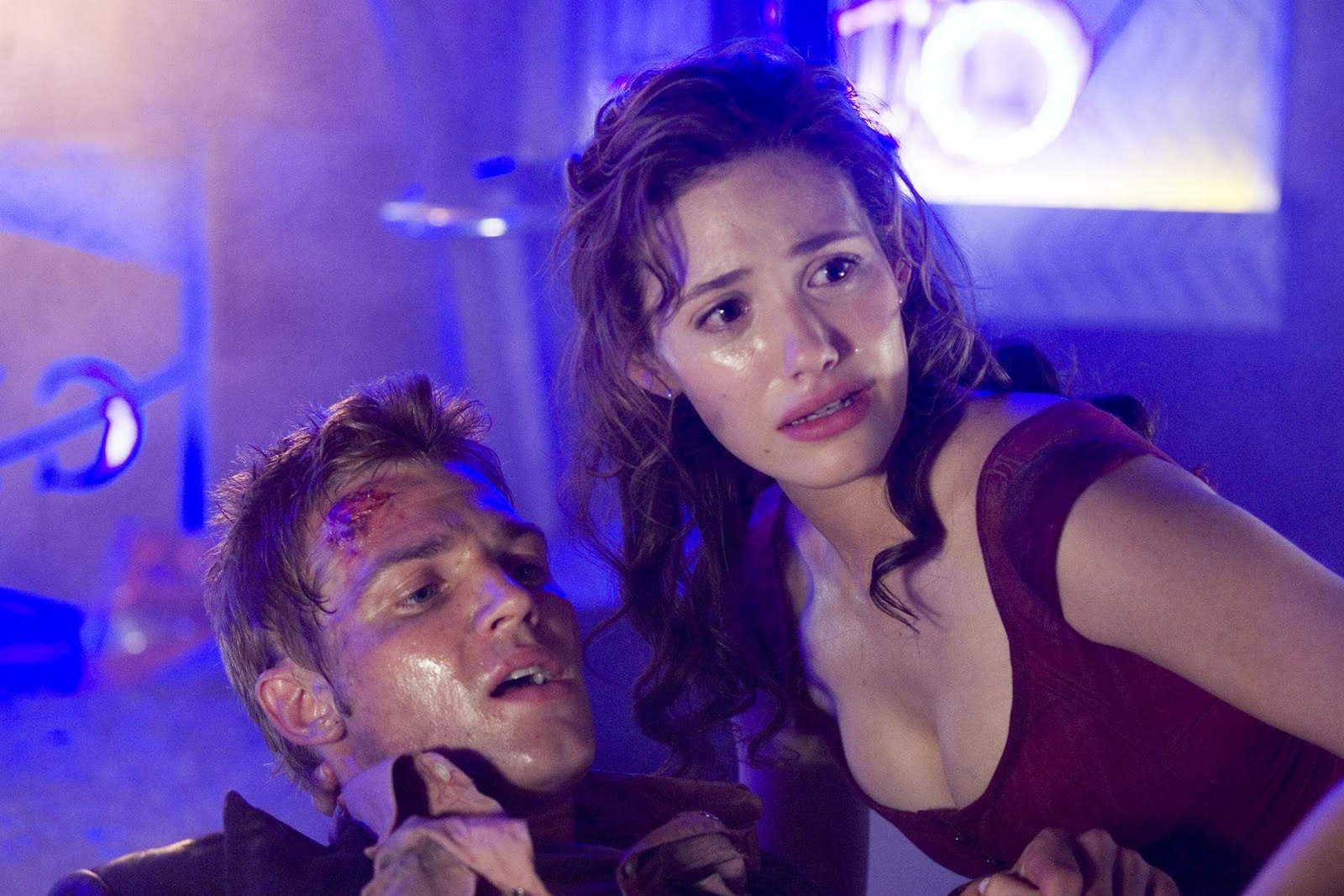
Our first sight of the ill-fated ship is breathtaking. Peterson follows lone jogger Dylan (Josh Lucas) as he runs around the deck, and in doing so he offers us a full 360-degree view of this magnificent liner in all its splendour. It’s a surprisingly graceful opening, but Peterson has difficulty displaying the same grace and style when it comes to introducing a few of the supporting characters. There’s former New York mayor Robert Ramsay (Kurt Russell), who is on board with his teenage daughter Jennifer (played by creepy waxwork Emmy Rossum) and is uncomfortable with her burgeoning relationship with boyfriend Christian (Mike Vogel). Elsewhere, Valentin (Freddy Rodríguez) is a cook helping smuggle stowaway Elena (Mia Maestro) on board, and Maggie (Jacinda Barrett) is a single mother who is on board with her son and quickly catches Dylan’s eye.
These characters are introduced to us in a clunky, cheesy and often cringeworthy fashion; and the opening 20 minutes of Poseidon is almost dead in the water. It’s as if Peterson is desperate to get these introductory niceties out of the way as quickly as possible; the sooner we meet everybody the sooner the director can start drowning them. Fortunately, we don’t have long to wait. Another character on board for this New Year’s Eve voyage is Richard Nelson (Richard Dreyfuss), a gay architect who has been jilted by his young lover. Nelson is standing sadly on the deck at midnight, ready to end it all, but just as he’s about to hurl himself overboard he’s interrupted by the small matter of a giant wave heading his way.
This is what we’ve come to see, and Poseidon doesn’t disappoint. The big moment, when the wave hits, is the very point at which Poseidon suddenly finds its feet. The extraordinary sight of this monstrous wave crashing down upon the ship is brilliantly handled by Peterson; a stunning melding of first-rate special effects and the director’s knack for depicting the destructive force of water. The passengers are tossed helplessly inside the boat as it slowly turns itself over, hundreds of bodies being flung across the screen and meeting their often unpleasant ends. You may balk at the countless anonymous deaths the film so flippantly chalks off during this single sequence; but you’ll probably just be feeling the adrenalin rush it evokes, and thrilling to the sight of Peterson proving exactly why he’s Hollywood’s go-to guy for water-based blockbusters.
Once the chaos caused by the wave’s initial strike has subsided, it’s time for our band of survivors to make their move. Dylan is the ringleader, ignoring the pleas of the captain (Andre Braugher) to stay put and telling anyone who’ll listen that he can find a way out of the ship. All the characters we were introduced to earlier are quick to follow Dylan (even though Josh Lucas surely has one of the least trustworthy faces in American cinema) and they slowly make their way upwards to the bottom of the ship; getting involved in a series of death-defying situations and trying to keep one step ahead of the slowly rising water level.
The subsequent action is nothing we haven’t seen in this kind of movie before. The characters continually find themselves in tight spots before escaping with seconds to spare, and Mark Protosevich’s screenplay democratically gives everyone an equal share of heroic and cowardly moments. The fate of the characters is mostly rather predictable - particularly in the case of the self-styled “Lucky Larry” (Kevin Dillon), whom most viewers will have tagged as dead meat the moment he appears - but Peterson does have a few surprises up his sleeve as well. An early scene in a lift shaft is given a neat twist, while the unexpected drowning of one character manages to be quite powerful.
Running at almost twenty minutes shorter than the 1973 version, Poseidon has little room for anything but action, and essentially it’s just one set-piece after another. But Peterson really knows what he’s doing with this material. 25 years ago he tore our nerves to shred by making us feel the awesome power of the ocean enveloping a German submarine, and here he gives us constant reminders of the water pressing on the ship, cracking windows, forcing doors. The action throughout the film is satisfyingly physical, and the best moments are in many ways the least showy. When the characters find themselves trapped in a tight air vent with nowhere to go, their fear feels surprisingly real.
There are undeniably numerous flaws in Poseidon. The poor characterisation is a major fault, with Lucas and Russell given the bickering Alpha male roles and everyone else feeding off scraps; and the fact that the survivors are all white while a number of black or Hispanic characters die along the way leaves a nasty aftertaste. Performance-wise, Lucas is uncomfortably miscast as the hero and Rossum is as wooden as ever, but Russell and Dreyfuss both give solid displays. The other thing which disappointed me about Poseidon was the fact that Peterson and his production team fail to exploit the visual possibilities of an upturned ocean liner. Instead of making their way through rooms in which everything is upside-down, the cast spend the whole film crawling through various shafts, vents and engine rooms; environments which are grey and indistinguishable whichever way you look at them.
Poseidon is unlikely to replace the original in the hearts of the public, and in all honesty the majority of viewers will probably start to forget it as soon as they leave the cinema; but, in a summer when the blockbusters have failed to really amaze in the desired fashion, the film at least offers a spectacular and entertaining show. You may well quibble about the wooden, cheesy script and one-dimensional characters; but it’s not really worth fighting this kind of stuff. The effects are great, the action is relentless and the film doesn’t outstay its welcome or take itself too seriously. Something exciting always happens when Wolfgang Peterson takes to the sea, and you’ll have plenty of fun if you just go with the flow.
 Since Bryan Singer’s first X-Men film appeared in 2000, the mutants at the centre of his story have had to deal with constant persecution from the government and the public, as well as fellow mutants who have turned bad under the leadership of Magneto (Ian McKellen). The good mutants, under the stewardship of Charles Xavier (Patrick Stewart), have handled all of these obstacles and come through the other side; but now they are faced with a threat which surely no mutant can overcome. No, not the ‘cure’ which has been developed to suppress the mutant gene; I’m talking about the awe-inspiring, destructive power of Mr Brett Ratner.
After Singer passed on directing the third instalment of this franchise, deciding instead to lend his talents to Superman Returns, the job was handed to Matthew Vaughan but, after a few weeks of production, Vaughan left the project as well. The producers eventually turned to Ratner, one of the most unimaginative, dull-witted hacks currently working in Hollywood, and gave him the task of providing a fitting finale for this franchise. But with Ratner at the helm, and after such a rocky development, it comes as little surprise that X-Men: The Last Stand is such a mess; such a shallow and insignificant waste of time.
The first two X-Men films weren’t perfect, but they were serious and intelligent films made with care and attention. Under all the expected blockbuster action, the films actually made a fair attempt to deal with very real social concerns, making their mutants a metaphor for anyone who has felt marginalized and ostracised by society. The Last Stand does little more than clumsily pay lip service to these underlying themes - with Ratner proving unwilling or unable to handle them - and what’s left on screen is nothing more than an empty spectacle.
The film starts badly, with a ‘20 years ago’ caption leading us into a scene where Xavier and Magneto (both looking like they’ve had a Botox overdose) first recruit the young Jean Grey. Suddenly, we jump forward to ‘10 years ago’ and find a young mutant engaged in a spot of self-abuse in the bathroom - slicing the wings off his back, that is. Then it’s time to hop forward to ‘the not too distant future’ and to catch our motley crew of X-Men engaged in battle with some unseen foe. Two things leap out at us from these opening segments. First of all, the jumpy start anticipates the absurdly choppy nature of the screenplay throughout the film, as it jumps wildly all over the place to little effect; and secondly we instantly learn that Brett Ratner cannot direct action sequences. This opening battle scene is barely comprehensible at times, with Ratner’s hectic approach causing confusion, and failing to inject any sort of tension or bring a tangible sense of threat into play. The first battle is eventually revealed to be just a simulation, a training exercise for rookie X-Men, but already we sense the director is out of his depth.
After a fashion, we are given something resembling a story. The big threat to the mutants’ existence here is a drug which claims to ‘cure’ the mutant gene, developed after a young mutant (Cameron Bright, who has mastered the art of the blank stare) was found whose powers seem to neutralise the power of any other mutant in the vicinity. This development motivates Magneto to lead his mutant army in a revolution against humanity, while everyone at Xavier’s school seems to be wallowing in self-reflection. Cyclops (James Marsden) and Wolverine (Hugh Jackman) are both mourning the death of Jean Grey (Famke Janssen), who perished at the end of X2; Rogue (Anna Paquin) quite fancies the idea of a cure which will enable her to touch her boyfriend without killing him; and Storm (Halle Berry) is moping about the place as well, although I didn’t quite catch her reason to be miserable as a sudden sense of apathy came over me whenever the world’s most insipid weathergirl appeared on screen.
Soon the X-Men are roused from their lethargy by the resurrection of Jean Grey, whose personality seems to have taken a turn for the dark side since her death. Her powers far outstrip those of anyone else in the film, and when the time comes for all the mutants to do battle, both Xavier and Magneto understandably want her on their side.
The Last Stand’s set-up could have been fully exploited if Ratner had shown the insight to focus his story on Jean (by far the film’s most interesting character) or Rogue (whose desire for the controversial cure could have given the film some emotional weight), but Ratner never gives The Last Stand any sense of focus and never shows a willingness to engage with the characters’ emotions in the way Singer’s earlier films did. Instead, the film becomes a series of set-pieces, each one bigger, louder and less impressive than the last; and the moments in between the various action scenes seem to be little more than filler material, marking time until something else blows up. The dialogue is utterly banal, and the film never displays a spark of wit, humour or intelligence in its 104 minutes.
Another major problem The Last Stand never manages to overcome is the sheer number of characters which are stuffed into every corner of the film. I always felt that X2 suffered from having too many characters running in too many different directions, but here there are even more mutants to get to grips with; and with so many new arrivals, the actors are inevitably feeding off scraps. Kelsey Grammer (looking like a particularly well-groomed Smurf) struggles to express any sort of personality under his heavy makeup and Vinnie Jones (an unfortunate relic from Vaughan’s short stint as director) is nothing short of embarrassing as Juggernaut.
There are more mutants to meet and greet along the way, but I didn’t catch half of their names and few of them are given any sort of purpose. At one point, Magneto literally announces a number of new members from a checklist, which pretty much sums up the perfunctory nature of these characters’ introductions.
It’s left to the series’ stalwarts to salvage this film, and they give it their best shot. McKellen and Stewart inject the same note of gravitas and class which they lent to the two previous films, but the one real strength of The Last Stand lies in the relationship between Jean and Wolverine. Janssen gives a performance full of intensity and passion as the woman torn between the two sides of her nature, and whatever sense of emotion the film does contain is provided almost exclusively by her. What a pity Ratner squanders this terrific display by making Janssen stand around in the background for so much of the film’s second hour, an observer who is far more compelling than the action in front of us. For his part, Jackman again gives a muscular and sardonic portrayal of Wolverine, and the scenes which these two actors share are comfortably the best The Last Stand has to offer.
What else does it have to offer? Not much. The film builds towards a climax which is spectacular and explosive but completely lacking in any sense of catharsis or consequence. The big set-piece, in which Magneto brings down the Golden Gate Bridge, is hamstrung by poor effects (noticeable throughout) and a remarkable continuity oversight which sees the action on the bridge take place during bright daylight, until the bridge hits the ground and we’re suddenly plunged into darkness. I assume Ratner decided the subsequent explosions would look a lot cooler at night and took the chance that nobody would notice the sudden shift; but this one incident speaks to a carelessness and contempt for the viewer which permeates the entire film.
If this is, as the title indicates, the last in the X-Men series, then it’s a sad way for a once promising franchise to end. When Singer left, it seems he took everything that was good about the X-Men films with him, and The Last Stand is a long slow death rattle. Or is it? Towards the end of the film a number of heavy hints are made regarding the possibility of yet another entry in the franchise; let’s hope these hints come to nothing. One of these late signifiers actually occurs after the end credits, but I’m sure a number of fans will miss it - they’ll already be filing their way slowly out the cinema, shaking their heads at the sad demise of their heroes. The evolution of the X-Men stops here.
 In the long story of football’s emergence as the world’s number one sport, the game’s struggle to secure a place in the heart of Americans has provided a fascinating subplot. With American football, baseball, basketball and hockey to contend with, football (or soccer) has never really managed to gain a strong foothold in the country; with the average Americans proving unwilling to follow a low-scoring sport played in continuous 45-minute chunks.
It’s a different story these days, of course. While Football hasn’t reached the level of popularity enjoyed by the original American sports, at least it has now found some acceptance, with more youngsters coming into the game and an established league which is growing in stature. The United States national team has qualified for every World Cup since 1990, and is now placed as one of the top ten nations in the world by the FIFA rankings. Finally, football seems to have found its place in American life, and many people would credit/blame (depending on your view) one man for bringing the beautiful game to the US - Steve Ross.
Ross was the CEO of Warner Communications. He was a dreamer, a visionary and a huge sports fan; so what could be a greater challenge than bringing an entirely new sport to the American public? Once in a Lifetime is a highly entertaining documentary which charts the astonishing rise, and inevitable collapse, of The New York Cosmos; the dream team Ross put together in his bid to change the face of American sport. It’s a story full of everything you want from a good documentary; money, clashing egos, sex, and scandal. As Rodney Marsh puts it, “The Cosmos were everything that was good, and everything that was bad, about football in America”.
Stylistically, Once in a Lifetime contains striking to similarities to recent documentaries such as Inside Deep Throat and The Kid Stays in the Picture; blending well-chosen footage with snappy editing techniques and a hip soundtrack, to create a film which makes up in entertainment value what it lacks in substance. Filmmakers Paul Crowder and John Dowder are more concerned with spinning a good yarn than giving an in-depth analysis of the Cosmos’ impact on the United States, and in this respect they certainly deliver.
Chief among Once in a Lifetime’s assets is its impressive line-up of interviewees. Steve Ross is no longer with us, but the filmmakers have managed to get almost everyone involved in the Cosmos’ rise and fall to open up on camera. Those who were Warner employees at the time and who helped him build his dream team are gleefully honest about their ignorance of the game, with Raphael de la Sierra admitting that he had no idea how many players a football team should have, and another contributor remarks “I didn’t know what a header was, I thought giving great head was something else entirely”. But Steve Ross knew what he was doing, and he knew that this sport would only leave its mark with the help of the world’s greatest player.
The purchase of Pele is where the story of the New York Cosmos really takes flight. One interviewee predicts that Once in a Lifetime will resemble Rashomon by the end, and with the amount of conflicting reports on show he’s not far wide of the mark. Everyone tries to claim the credit for signing Pele, and nobody can agree on just how much money the Brazilian earned; but what’s beyond dispute is the fact that Pele earned millions during his brief stint in America, and the sport suddenly leaped onto a new level as soon as he set foot in the country.
Pele is sadly absent from the roster of contributors. With his own autobiography and documentary to promote he has declined to take part (although the fact that Crowder and Dowder cheekily announce his decision with the sound of a cash register may indicate the real reason behind his non-appearance), but the range and quality of interviews on offer still provide great value. There are some great anecdotes on offer here, recalling the sheer craziness which surrounded this team. There’s the way the dreadful pitch was spray-painted green in preparation for Pele’s debut; goalkeeper Shep Messing’s attempt to gain exposure for the team by posing nude; and Franz Beckenbauer laughingly recalls Mick Jagger’s surprise appearance in the dressing room. Onetime Tampa Bay Rowdies star Rodney Marsh tells of his first interview in the US, when he was asked if he was “the white Pele” and he replied “no, Pele is the black Rodney Marsh” - a comment which is followed by footage of Marsh being clattered to the ground by the Brazilian in his first match.
Once in a Lifetime even has a pantomime villain on show, in the shape of Italian striker Giorgio Chinaglia. Chinaglia was a goal machine who joined the Cosmos revolution and immediately began disrupting the dressing room harmony with his criticisms of Pele and egotistical behaviour. “He was Italian, scored a lot of goals, spoke English with a Welsh accent - and that’s about all the good things I can say about him” remarks a former team-mate, and few of those interviewed seem happy with the way Chinaglia became Ross’s confidante and slowly exerted his influence all over the club. This was the beginning of the end for the Cosmos, but Tony Soprano lookalike Chinaglia seems unperturbed as he chuckles through his reminiscence.
Once in a Lifetime is a tad uneven in places, and doesn’t really explore the reasons for the Cosmos’ failure or its influence on American culture in any great depth, but it’s as slick and stylish a documentary as you’re likely to see. Snappy editing is the order of the day as Crowder and Dowder put their footage and interviews together with a consummate ease and professionalism. Matt Dillon narrates in understated fashion, and the funky soundtrack helps keep things lively, with a number of 70’s hits present alongside some footy favourites such as Nessun Dorma. Unfortunately these songs are occasionally a little too literal in relation to the action, and setting a montage of Franz Beckenbauer goals to Ride of the Valkyries was perhaps ill-advised.
The Cosmos eventually imploded as the sport failed to catch the attention of the American public. But the film doesn’t paint Ross as a failure; in fact it could be argued, in this era of Real Madrid’s Galacticos and Chelsea’s Abramovich revolution, that his only mistake was being thirty years ahead of his time. Football is now a thriving pastime in the US and it’s shame Ross didn’t live to see his dream bear fruit, as he died in 1992, two years before America would host the World Cup.
Once in a Lifetime does suffer from the absence of its two biggest players, Pele and Steve Ross, but it still offers enough superb footage, hilarious stories, and toe-tapping music to make it worth a look. With the domestic season over, and the World Cup yet to begin, football fans everywhere will surely be delighted to hear that Once in a Lifetime guarantees a terrific ninety minutes.
 Purely in terms of box-office, The Da Vinci Code is a sure thing. Dan Brown’s novel has become one of the most successful books of all time, with various spin-off books raking in even more cash, and television programmes debating the potential for truth in what is, essentially, a fairly preposterous work of fiction. Now the Hollywood version has finally been inflicted upon us. With one of the most mainstream-friendly directors in cinema at the helm, an A-list cast on board, and a ready-made fan base ready to swallow the movie whole regardless of quality; it’s a recipe for success which surely can’t fail.
On a business level, the makers of The Da Vinci Code haven’t failed - their film is going to be a huge financial success come what may - but as an artistic endeavour, the film is an utter catastrophe. It’s hard to pinpoint exactly whether this mess is the fault of director Ron Howard, screenwriter Akiva Goldsman or Brown himself, but I’d argue that the attempt to put this story on screen has thrown the inadequacies of all three into sharp relief.
As one of the handful of people in the western world who haven’t yet read The Da Vinci Code (and after this, never will), I can’t really comment on the film’s handling of the translation from page to screen, but others have assured me that Goldsman’s adaptation is relatively faithful, so the blame for this film’s ridiculous plot must lie with Dan Brown. The story, such as it is, follows Robert Langdon (played by a permanently constipated Tom Hanks), a renowned cryptologist who is called in by the French police when a curator is found murdered at the Louvre. We’ve already seen how Jacques Sauniere (Jean-Pierre Marielle) met his maker, shot by murderous albino monk Silas (Paul Bettany); but after taking a bullet, it seems Sauniere still had the time and the will to take off all his clothes, make strange markings on his body, leave cryptic messages all over the place, and die in a pose which recalls Da Vinci’s Vitruvian Man. Wow, what a way to go.
The clues Sauniere left will lead Langdon on a quest to uncover a secret which has been buried for thousands of years; namely, that Jesus married Mary Magdalene, had children, and his descendants are walking the earth to this day. Langdon is aided in his crusade by Sophie Neveu (Audrey Tautou), a pretty police cryptologist who also happens to be Sauniere’s granddaughter, and by Sir Leigh Teabing (Ian McKellen), an eccentric (i.e. English) expert on the various myths and legends surrounding Jesus. Standing in our heroes’ way is a no-nonsense French copper named Bezu Fache (Jean Reno) and the aforementioned Silas, who enjoys nothing more than a spot of self-flagellation as a respite from all those nasty murders.
The Da Vinci Code follows a very straightforward narrative structure. Landon and Sophie find a clue, explain in detail what this clue means, and then they are led to another clue. Occasionally, they find themselves escaping death by the skin of their teeth (they are saved by a pigeon at one point) or getting involved in a fight with Silas. This pattern is repeated ad infinitum throughout Goldsman’s leaden screenplay, and The Da Vinci Code quickly reveals itself to be a terrible bore.
Goldsman’s adaptation, whether it does remain faithful to the book or not, is a simply dreadful piece of screenwriting. Had The Da Vinci Code never existed in book form, it’s almost inconceivable that a screenplay this bad would have ever been made. Admittedly, there is a lot of exposition which the film needs to get across to the viewer in places, but Goldsman’s approach seems to assume that the audience need to be spoon-fed every single little piece of information lest they should find it hard to keep up. Whenever Langdon and Sophie discover something, they have an unfortunate habit of shouting it out to each other a couple of times to make it plain for the viewer. In fact, nobody in The Da Vinci Code ever seems to say anything which isn’t expositional in some way - it’s all plot, plot, plot; and character or emotion doesn’t get a look-in. With so little to work with, it’s unsurprising to see the actors’ performances suffer.
Poor old Tom Hanks. Stuck with a bad haircut and no character, Hanks struggles to invest some sort of life into a hero who never gets to do anything heroic. He is one of the most intelligent and likeable leading men in American film, but he looks thoroughly miserable here and the result is one of the few really wooden and charmless performances I’ve seen him deliver. Audrey Tautou has to face the twin obstacles of (a) acting in her second language and (b) uttering Akiva Goldsman’s unspeakable dialogue, a double whammy few actors could overcome. Paul Bettany is slightly more interesting as Silas, giving a committed display which is full of intensity, but he’s never really scary for all his commendable effort.
Some relief is provided by Ian McKellen’s appearance after a very long and dull first hour. McKellen has the good sense to not take this nonsense seriously, and his amusingly arch turn thankfully alleviates some of the tedium which descends on the film. McKellen tends to be at the centre of the film’s better moments, offering some of the few intentional laughs (as opposed to the numerous unintentional laughs elsewhere), and he is such a fine actor that he can convincingly switch moods in an instant.
Unfortunately, such relief is hard to find in The Da Vinci Code’s numbing 149 minutes. During the second half of the picture the action switches from Paris to London, but the change of scenery can’t disguise the fact that the plot stopped making sense a long time ago, and the final half-hour falls embarrassingly flat.
Ron Howard seems completely lost with this material. To make The Da Vinci Code work, you’d need a director with a taste for the gothic and macabre (Oh, for a latter day Hitchcock), but Howard’s trademark blandly inoffensive style brings nothing to the party; no atmosphere, no spark, no style. Howard also commits the cardinal sin of overloading the film with an excessive amount of flashbacks. Every time a character mentions a historical event, we are transported there to witness it, and each character also gets a little mini-movie depicting their own past traumas. However, these flashbacks tend to obscure and confuse matters more than they clarify, and they just make this overstuffed, horrendously edited film even more bloated.
Prior to The Da Vinci Code’s release there has been a maelstrom of controversy surrounding the film’s central ideas, its stance on Christianity, and its depiction of albinos. To be honest, it’s really not worth the effort. Nobody should do this ludicrous film the honour of being offended by it, and the only thing that truly is offensive about The Da Vinci Code is how bad it is. The Da Vinci Code is an illogical, uninteresting, borderline incompetent film which is a failure on almost every level; but does it matter? Regardless of critical opinion, fans of Brown’s book will still flock to screenings with zealous enthusiasm, and it will undoubtedly be one of the biggest hits of the summer. There may be nothing of value here, but the mystifying success of The Da Vinci Code shows no signs of stopping.